
On The Road Again
Self drive not only saves money, it also affords you much greater freedom and flexibility. When we started Faraway Fairways we were open minded about which transport solution was best. Over the years however, we’ve come to believe that self-drive is the more desirable
We do however come across folk who really don’t want to self-drive. If that’s the case, then please don’t put yourself through something that is only going to become a source of stress or inconvenience. It’s not worth it. We can use hired drivers instead, although this can also limit us a little bit terms of our ‘reach’
There are some things that we’ll need to ‘take-on’. We might as well run through these, but by the same token you shouldn’t be too alarmed. Hundreds of thousands of visitors face the same thing every year and just about every single one of them manages
- We will have a right-hand drive vehicle
- We will need to drive on the left-hand side of the road
- We will encounter strange road-signs and highway laws that we’ll need to adapt to quickly
- We will encounter unfamiliar things like ‘traffic roundabouts’ and ‘giving way to the right’
Driving in some overseas countries might resemble the ‘wild west’. The UK isn’t one of them. The UK’s roads are comparatively well regulated.
The same is true of Ireland, although we would regard Scotland as having the better road infrastructure. Ireland does begin to degrade once we leave the major cities
Seating capacities are rarely an issue on a golf trip. Luggage however is.
Golfers invariably require a bigger vehicle than their bare number suggests they should. Each golfer will normally generate a single luggage item, plus a golf bag. We’re afraid golf bags are notoriously awkward. Once our party reaches three people, we’ll need an MPV. Don’t be tempted by someone telling you an ‘estate car’ will work, even if it does (and some of the larger models can just about to do this) the level of ride comfort will be heavily degraded (especially if you’re the back seat passenger with a 3-wood clanking around your ears!)
A single person can use a medium sized ‘saloon’ car. Although a ‘hatchback’ would also have the capacity to support a single person, we don’t normally advise their use. They might be good for parking, but they can be a little bit underpowered
A two ball party should be looking to use a ‘large estate car’, or a large saloon with the ability to fold the back seats forward for a full luggage carry
Three is the number whereby we have to use a nine-person MPV
An Multi Purpose Vehicle (MPV) has luggage capacity for nine items (four players with a golf bag and suitcase each). Tee times are of course sold in fourballs. It works out well.
One thing to be aware of however is that a majority of golf parties are likely to be seeking to play the St Andrews Old Course through the various ballots. When we win a ballot we not only have to change to plans for the day concerned, we also have to try and rearrange any course that we had to cancel to make way for St Andrews. This means we need to adjust our transport plan again when we restore the round
A lot of visiting golfers can overlook the transport disruption that this causes. We can have a situation where we suddenly have a clash for the use of the vehicle if one fourball needs it for Carnoustie at the same time as another one needs it for a rearranged round in Dumbarnie
Don’t be tempted to try and cut back on the transport by using a vehicle short of what would be necessary to cover all our angles. We’re a lot better off trying to operate autonomous fourballs with a vehicle for each group
It’s possible to operate a multiples of four strategy in convoy, but eventually we might need a larger capacity midi-bus/ coach.
We aren’t really sure where the cross-over for this is?
Faraway Fairways have certainly used a mini fleet of MPV’s for groups of sixteen before, but by the time we get to twenty we need to start possibly thinking about bringing in a mini-coach and switching onto a hired driver model
If we choose to do this however, it would be a massive tip to introduce a single MPV into the party so as to allow us to perform independent ‘run around tasks’ rather than finding ourselves hostage to a booked driver who might have ‘gone for the day’. Critically, It also gives us the opportunity to respond to any St Andrews Old Course ballot wins (although we will need to nominate a series of named driver to ‘take the reins’ as necessary)
Motorways (blue signage) are probably the easiest roads to drive on. They’re essentially international in their design. Any capable driver shouldn’t have any difficulty adjusting to them quite quickly. So long as we can observe ahead and behind, and maintain a good lane discipline they’re the nearest thing we’ll encounter to ‘point-and-go’. Anyone landing at Edinburgh airport is quite lucky in that we’ll potentially be onto a motorway within a few minutes if heading north or west.
‘A’ roads are also fast moving (dark green signs) but entry onto the carriageway from vehicles joining isn’t quite as well structured as a motorway, and we can encounter a few more quirks which require greater diligence and observation
The A9 is Scotland’s longest road and links Edinburgh with Inverness (it runs past Gleneagles). The A1 is actually an ancient Roman road and we should briefly use it if driving to North Berwick or Muirfield from Edinburgh
Driving in built-up areas is likely to be where we’ll encounter the most difficulty. Ironically however, very congested traffic isn’t too much of a problem given that it usually involves gridlock. Traffic jams give us a lot more time to observe and watch others performing manoeuvres. They also involve slow-speed ‘crawling’. Glasgow, Edinburgh, Belfast and possibly Aberdeen are the only cities where we’re likely to encounter issues. We can avoid central Dublin in most cases by staying at Portmarnock.
The most frequent problems we’ll encounter are right-turns, which now feel counter-intuitive, and roundabouts where we need to observe and ‘give way to the right’.
The most disconcerting conditions are probably heavy, but free-flowing traffic where thing scan begin to happen a little bit more quickly. The time of day can influence this
Driving in Scotland’s rural areas is often considered to be something of a legitimate leisure activity within its own right. The roads are uncongested and frequently scenic, particularly those of Perthshire and the Highlands. Drivers need to be disciplined and remember that their responsibility is to the road. Don’t get caught looking for monsters in Loch Ness is driving on the A82 for example
The A82 and the A9 are two trunk-roads that travel through both areas linking them to the central belt
One of the biggest challenges we might face is losing concentration as a result of not necessarily having enough other vehicles around to keep us focused. There is an issue with drivers who are used to driving on the right to start doing so. Modern vehicles do have smart alert ‘bleepers’ to warn us if we’ve crossed a white line without indicating, and an attentive passenger is always a help too. These needn’t work quite so well on rural roads with poorer lane markings however. We shouldn’t rely on them, and should treat as a possible safety net instead
The quality of rural roads in Scotland (and Ireland) is poorer (as you might expect). It might be necessary to adjust our speed accordingly. We don’t want to hit a pot hole at speed and to spring the airbags out
All of our self-drive vehicles will come with an audio ‘sat-nav’, although clients are increasingly choosing to rely on their own apps for this purpose
Faraway Fairways produces a travel plan for you which includes postcodes for programming into the ‘sat-nav’ and estimated ‘last-time’ to leave in order to arrive at place X by time Y
We will nearly always be able to provide you with an automatic transmission so as to give you one less unfamiliar thing to concern yourselves with (we can’t recall a situation where we haven’t done)
Testimonial
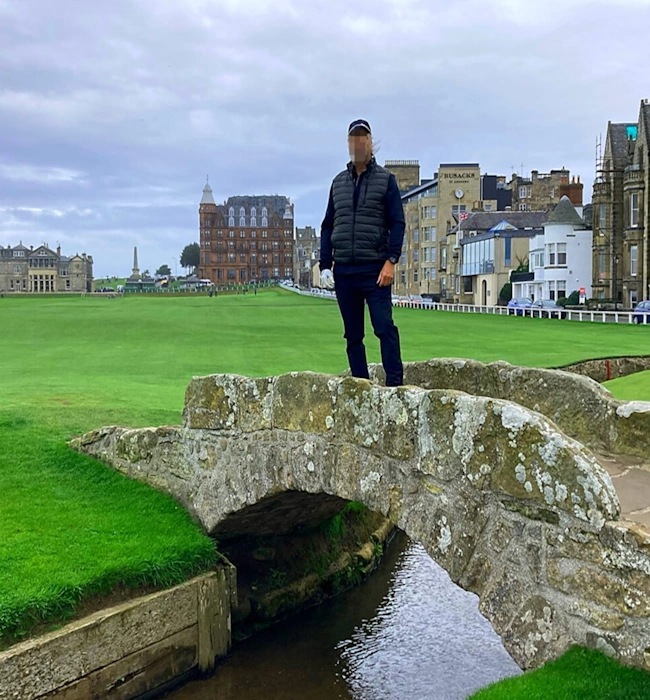
From BB Canada
“I told Alun the courses I was interested in playing and he prepared a stay and play package with 14 days of outstanding golf, but also tremendous site seeing opportunities for my wife.”

From JC Illinois
“His attention to detail is amazing--I think our travel plan booklet ran to forty-eight pages, with gorgeous descriptions of cities and sights, plus maps showing where to go to catch trains, or walk from trains to hotels, sights and golf courses, etc.”

From DF Alabama
“I will cherish the memories for a long time- especially the wonderful times spent on and off the golf course with two of my brothers and brother-in-law. None of the memories and golf would have been possible or enjoyed without your tremendous planning and logistical support.”

AS from Colorado
“Alun and Faraway Fairways created possibly the most memorable golf trip we have ever experienced. EPIC is the only word that comes to mind.”
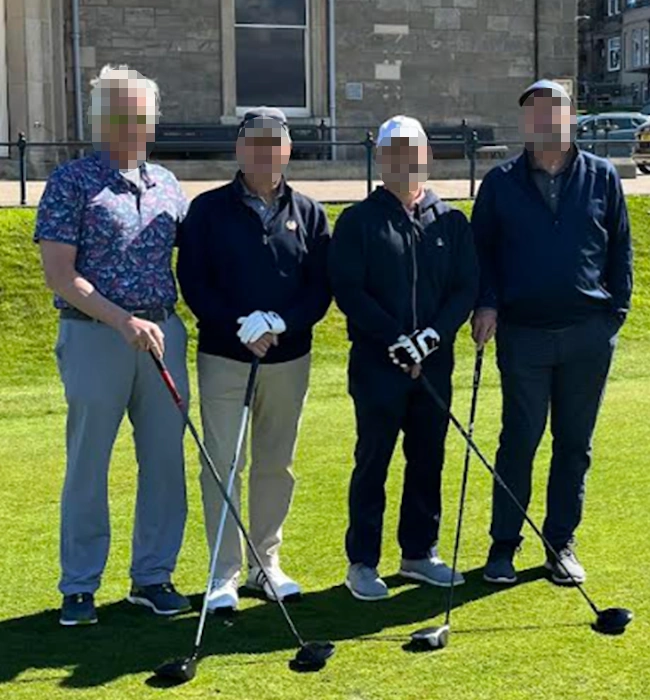
AC, From Florida/ New York, 2025
“We were hopeful to secure a 4 ball at St. Andrews while avoiding the massive expense other operators had quoted. He was very clear about the plan for achieving a tee time at the Old Course through the ballot, including detailed instruction on how it could be done, and what our odds were. He suggested mid- to late April as the best chance of success and advised that this is also the least rainy part of the year. We took his advice and trusted the process. Well, he was right on all counts!”
From SB, Minnesota
“We wholeheartedly recommend Alun and Faraway Fairways if you’re looking for a golf trip that is effortless, enjoyable, and truly unforgettable—even for a non-golfer in the mix! My husband and I will be daydreaming about this trip for years to come. 5.5 stars!”

From JB, California
“The best part was that the service was surprisingly affordable. They were thousands of dollars below other quotes that I received, in fact the prices were very similar to what I would have paid if I would have booked everything on my own.”
From JCA, Maryland
“I would and will highly recommend your company to anyone looking to plan an unforgettable golf trip. Thank You for putting together a fantastic trip for J.C. and me”
From WF Connecticut
“I think all eight of us would agree that Alun at Faraway Fairways did an absolutely wonderful job of putting this “golf vacation of a lifetime” together for us. His focus on the details was extraordinary from the choice of courses and the timing of the tee times, the amazingly beautiful accommodations along with some excellent meal selections, and the transportation options he provided to get us from place to place.”
From DR South Carolina
“You are about to tee it up in your Major. Seek wisdom, integrity and professionalism. Alun Davies and Faraway Fairways will not disappoint you. They cannot assure a calm sunny day with temperatures in the 70’s on the Old Course.”

From MM, California
“One fantastic trip you organized, and more importantly took ownership of in terms of daily communication and stewardship during our 2+ weeks in Scotland and Ireland. The logistics were spotless…100% of the transports were on time and excellent, the lodging choices spectacular and the golf was off the charts in terms of quality and arrangements made”
DH from California
“You cannot go wrong with the support Faraway Fairways offered. I did this trip solo and all last minute but I have already begun to plan the next trip which will include my best golfing buddies.”
Enquiry
We don't need to make this an ordeal by 101 filtering questions! In reality there are probably little more than half a dozen things we need to know to build out a proposal. The guidance below might help you frame answers
Duration - usually best expressed as a range up to a maximum
Time of year - can be anything from a specific date range to a named season
Travel class - Faraway Fairways uses 'Luxury', 'Premier' or 'Affordable' for generic purposes. You might choose to reference the international 'star' rating system. We're only looking for something to help steer us into the right sector
Self drive or hired driver - In broad terms, self driving is normally less expensive, and much more flexible, but some folk just don't want to do it
Must play courses/ must do places - a few name checks is all that's needed