
Background Context
Once upon a time there was a mechanism called the ‘walk-up’ rule that allowed single golfers, or as was it was more commonly used, golfers who had failed with their open ballot applications, to approach the starter on a ‘first come, first served’ basis and ask to be slotted into any open slots remaining in the days tee-sheet. This typically meant queuing anywhere between midnight to 02.00, until 06.30 the next morning. Dedicated golfers were prepared to do this, and it sort of worked.
The Post Covid Travel Boom
Post covid however we witnessed an explosion in overseas golf travel. Players were suddenly finding that they needed to queue from about 19.00 the night before and lay siege to the Starters hut for about 12 hrs. The Walk-Up queue began to resemble a rough sleepers camp, and it started to become a bit unsightly (remember the links are managed on behalf of the townsfolk who are technically the owners). Leaving aside the increasing level of complaints the queue was creating, the endurance needed to prosecute a walk-up was clearly discriminating in favour of young, able-bodied, males. Anyone who might have sought to challenge the way that the Links Trust were distributing these tee-times would almost certainly have won their case. The Trust elected to get out ahead of this inevitability therefore and introduced the Single Ballot
Unlike the Open Ballot, local players don’t tend to contest the singles ballot on anything like the same scale. They don’t need to.
Someone who lives close to St Andrews isn’t under any time-expiry pressure to play. They can continue contesting open ballots and just wait until their name is drawn. This removes about a third of the field (remember, we are ultimately competing against other golfers for availability) so anything that thins out the competition is beneficial
We can also find that two-ball parties prove reluctant to contest the singles ballot as well, or if they do, they’re a lot more likely to decline an offer if they win one, and lose the other application.
All this helps make the singles ballot the most productive pathway to play, but it does create other issues for us too
In 2024 the St Andrews Links Trust (SALT) abolished the old “walk-up” rule and replaced it with the “singles ballot”. The walk up rule was traditionally used as something of a safety net, albeit it was increasingly requiring some extreme siege tactics and endurance stamina to execute it.
The singles ballot offers us a second chance to contest the same ballot that we might have lost 24 hrs earlier, albeit this time you have to apply as a single golfer rather than a group
In crude terms, they’ve swapped something that had a quite high daily strike-rate, provided you were prepared to use it aggressively, (the walk up rule), for something that will have a lower daily strike-rate, but which will allow you to make more attempts
You can only make one attempt per 24 hr cycle however, but you can string together a series of applications over a number of days, which was something that fatigue made pretty much impossible under the walk-up arrangement
The open ballot is drawn for two-ball, three-ball or fourball groups. If your groups number is selected by the Random Number Generator (RNG) or ‘the computer chooses you’ as the Trust describe it, then you all play. This naturally means that there are three-ball and two-ball groups in the tee-sheet who will be made up to a fourball. The singles ballot allocates these gaps
There is also a ‘local ballot’ that is drawn alongside the open ballot. Local golfers are given the option whether or not to accept someone from the singles ballot into their group. Typically about 60% of them will, but some will decline to
There is also such a thing as illness, transport failures, and any end of reasons for a ‘no show’ on a tee-sheet. Anyone failing to take up their tee-time can be replaced from the singles list
It stands to reason that the more open ballot slots that there are in a tee-sheet, the more singles opportunities there will also be. This is true, and it tends to work.
It follows therefore that Saturday is normally the most productive day of the week, followed by Thursday
Only the golfer(s) concerned can enter the singles ballot. You will need to present to the Old Pavilion in person to do so the day before you wish to play.
Unlike the Open Ballot, no third party is allowed to enter on your behalf. The process will need repeating each day you wish to contest as a single.
- You have to enter in person
- You have to enter as individuals
- You have between 09.00 and 17.00 to enter each day, for play the following day
- Results are then notified to you at about 18.00
- You’ll be given a direct tee-time, or a standby number (you aren’t informed that you’ve failed but a high number is as a good as)
Acceptance of an offer is the default unless you take the option to decline
Note – we did receive a report from 2025 that the deadline on a Sunday for play on Monday was 16.00
Let’s look at the basics first
You will be notified of the outcome at about 18.15 on the day of entry by phone/ text, for play the next day
You might be offered a confirmed tee-time, or you might be issued with a standby number.
The standby number is dynamic and will continue to fall as people play, decline the offer, or fail to respond if called.
As a general rule, there is a 10% attrition rate from the 18.15 notification to about midnight. This is probably caused by two-ball applicants where one person wins, and the other loses, with the winner deciding to step down without their playing partner winning on the same day
This has similarities with a traffic light system.
A high number is tantamount to ‘no chance’ (red light) and can be functionally regarded as a loss. Go and do whatever it was we had planned and we’ll try again tomorrow etc
A low number can be tantamount to a win in everything but formal name (green light). Golfers drawn with single digits will nearly always play
Then there is the middle ground (the amber light). This requires us to make a choice and its never easy to decide what to do. Shall we leave St Andrews or play elsewhere as planned, or shall we stick it out and hope that people ahead of us when faced with the same decision have abandoned and can’t get back to St Andrews in time in the event of being called, allowing ourselves to advance. It is sometimes possible to make rapid advances towards the end of a tee-sheet standing our ground like this and come through with a late run
Asking for guidance of the Links Trust isn’t always that helpful. They’re understandably reluctant to build up hope in a golfer. If they misjudge the situation and advise someone that they’ll succeed and they don’t, then they’ll likely be facing the wrath of the individual concerned, “you promised me etc” so their instinct is to be cautious. To illustrate this, we can think of six occasions when clients with a marginal number were advised that they wouldn’t succeed, and Faraway Fairways advised that we thought they would if they stood their ground and held their nerve. On five of these we were correct, but in truth its not a nice position to find ourselves in at all, and we’re only working off guess and hunch (plus a few other insights we might use).
Any stand-by numbers that we’re issued with, will have different prospects of success dependent on the month of the year and the day of the week. For example, #25 for a Saturday in June, we’d expect to play. #25 for a Wednesday in September we’d expect to fail
This is one area we haven’t been able to get to the bottom of yet, and wouldn’t be certain that two different regimes might not be in operation dependent on the month of the year, as we’ve seen both apply. Our attempts to seek clarification from the St Andrews Links Trust has only resulted in contradictory answers
Is the standby number issued after the any tee-times have been awarded? or is it issued as a straight draw and the tee-times filled in later? We’ve seen both operate, and it makes a big difference to the interpretation of a tee-sheet, specifically the number of identifiable playing spots unfilled, and the likely number that will be required to get one of them
We’ve seen golfers being issued with numbers and then the first six being requested to report the next morning at 06.30. They’ve usually all teed off by 08.00. Under this scenario #1 to #6 would be tantamount to ballot wins, but they were issued with a low number rather than a specific tee-time. This would probably mean that someone drawn #20 stands a much better chance than they realise, as they could be as low #8 in effect
We’ve also seen golfers issued with a tee-time, and the numbers followed after. So if there were 12 slots in a tee sheet, these would have been filled, the #1 stand by number would be the next one to play. In effect, #1 was actually drawn #13 in this scenario, but only awarded #1 once the other 12 had been made up into the tee-sheet
The cost of the green fee is the prevailing retail price at the time. This is paid by you to the Links Trust. There are no penalty charges or hidden extras on the Singles Ballot
We’ll explore the disruption that split results can cause further down this cascade when we look at group size, and the problem of maintaining integrity in the playing numbers
The biggest drawback to entry otherwise is the requirement to present in person to process an entry between 09.00 and 17.00 .
This is different to the open ballot which allows us to contest it remotely from anywhere in the world at 48 hrs
If we’re unable to get into St Andrews during this application window, then we can’t enter. This begins to have implications for where we might stay the night before, the courses we might choose to play when staying in St Andrews, or the tee-times we seek on those courses.
You might also note of course that this restriction can also help to thin the field out too
As we’ve already noted, the singles ballot is something of a reflection on the open ballot, as it’s basically populating the same tee-sheet, albeit 24 hrs later
This means that success rates also fluctuate in line with the month of the year, and day of the week
- In 2024 Faraway Fairways enjoyed a 51% daily success rate.
- In 2025 this fell to 43%
We would expect this to continue falling as a new system begins to establish itself and golfers become more familiar and accepting of it. If we had to guess, we think it’ll likely level off at about 25%
This is key to any appraisal of the singles ballot and the strategy we might adopt
When someone(s) wins a singles ballot they fall out of the playing party for that day in order to play the Old Course instead. This could mean that we’ve had to cancel a course on their behalf that they wanted to play. That being so, we’ll need to rearrange this tee-time for them, otherwise they’ll forfeit that green fee. So not only is their ballot win disrupting the day of play it falls on, it’s also threatening to disrupt future tee-times and possibly require a different transport solution to get them to and from the rearranged courses as well.
In a worst case scenario, they can begin following their own itinerary, effectively having been shed from the main group, until such time as we can work them back into it
This is much less of a problem for wins that clash with other St Andrews courses. If singles ballot winners and losers stay in St Andrews on the same day, then all we’re really requiring them to do is play different courses. We can pick up the rest of the itinerary again the next day
It’s also much less of a problem in large groups too. If we’ve got a lot of golfers contesting the singles ballot then we’d expect to win more than just the one tee-time on any given cycle. This means that the affected players won’t be getting isolated and required to continue solo until we can break them back into the main party
It can become more of a problem on smaller parties though
The level of disruption that a large group faces isn’t anywhere near as pronounced as smaller parties encounter. Perhaps the best way to illustrate this is a hypothetical example
If we have a 12 person party, and everyone applies to the singles ballot, we might expect to win 4 tee-times and lose 8 (for example). The four winners can form a functioning fourball for the remainder of the trip until we can restore everyone to the same itinerary again. We can accommodate odd numbers too. The minimum number of wins we probably need is 2
We’ll spare you the mathematical explanation as it becomes complex, but there is an argument in favour of everyone continuing to contest ballots (regardless of previous success) as it potentially provides playing partners for any new winners on their rearranged rounds that they might now face. Remember you don’t have to accept an offer, so we might as well enter under these circumstances since we can always decline and everyone above the person who did so just moves forward one spot
Although we’ve had 4 wins from 4 attempts before, it isn’t really a very likely outcome. It would be prudent for a fourball party to consider how they’re going to respond to a split result, as this is what we’ll likely face.
A fourball party is unlikely to face quite the same agonising choices as a three ball or a two-ball because they’ve got more active participants contesting ballots, but there are still scenarios where they might struggle to reconcile
If you can agree ‘everyone for themselves and best luck’ beforehand, that would help, but that might be easier said than done
A fourball party at least has the option of accepting 2 wins and 2 losses. This result doesn’t quite break up the integrity of the party to the same extent as we’d see in a three ball or two ball where one golfer gets isolated. A fourball can function as a pair of two balls if need be until such time as we can restore the structure. There is a trick we look to perform revolving around the St Andrews New Course which can help us draw everyone back together quite quickly, but there is a chance that we’ll need to play a couple of rounds on separate itineraries until such time as we can bring everyone back into formation
The burden of 1 win and 3 losses will probably fall on the winner. They are both the beneficiary of the ballot result, but also the victim of any rearranged rounds that they might now need to play solo if they wish to recover them rather than forfeit. They might regard this as an acceptable trade in exchange for their Old Course tee-time though? It’s probably their call, but they should remember that they might be generating a new transport requirement as well as a new tee time elsewhere
3 wins and 1 loss poses us a different question. The 3 winners are the beneficiaries, but the single loser now becomes the victim (they lose twice in other words) not nice!
Realistically though, are three successful golfers really going to accept that they can’t play the Old Course because the fourth person in their party lost? Equally, is that unsuccessful golfer really going to ask the other three to step down too?
The three ball party is likely to face a quite testing dilemma because they’re an odd number. Unlike the two ball party who can possibly operate ‘both play or no play’, the three ball party will find it a lot more difficult to apply ‘all play, or no play’ (which would be their equivalent compromise). Landing 3 out of 3 is statistically unlikely (more so than 2 out of 2), so the probability is that a three ball contesting the singles ballot is going to face the choice of how to respond to 1 win and 2 losses, or 2 wins and 1 loss. This might be a ‘nice problem to have’ at one level, but it isn’t easily resolved unless you’ve agreed ‘everyone for themselves and best luck’ beforehand
This split win scenario is going to cause the odd number to become isolated. This potentially applies not only on the day of play, but quite possibly for any rearranged round(s) that we cancelled in order to take up the Old Course tee-time, and later restored to another date. The other golfer(s) will have played that course by then already.
There is a trick we look to perform revolving around the St Andrews New Course, which can help us draw everyone back together quite quickly, but there is a chance that we’ll need to play a couple of rounds on separate itineraries until such time as we can bring everyone back into formation
This is hardest group to settle on, and there is no right or wrong answer. If we have two wins, or two losses, we have a degree of clarity. You will need to decide how you respond to one win and one loss though? In broad terms you have two options
- Both play or no play
- Everyone for themselves & best of luck
Either strategy is justifiable. It just depends on your own personal stance(s)
We sometimes see a winning wife stepping down if the husband loses (don’t very often see it work the other way round incidentally). Father & Son two-balls also seem to feel a sense of obligation as well.
Traditional golf buddies are more inclined to play. They face the dilemma of the successful golfer pretending to be disappointed for the unsuccessful one, and unsuccessful golfer pretending to be delighted for their successful playing partner!
OK, we’re being a bit flippant and we should acknowledge that golfers are actually quite honourable people. It’s certainly not unusual to see the successful golfer offering to step down to keep the integrity of the two ball together, and the unsuccessful one imploring them to play
We’re always asked this – and the answer is ‘no’, you aren’t allowed to change a name or surrender your tee-time to someone you nominate
There are a few ‘sensible things’ we can do that might help tip a marginal number in our favour, (and have done in the past already). Might we call them ‘tricks’, we don’t know (tricks sounds a bit underhand, and that isn’t the case)
They largely revolve around an appreciation of human nature, and anticipating certain reactions to information or situations, and then taking steps to possibly capitalise on it. Some of the other ‘tricks’ are common sense responses to an appreciation of the mechanics of the system.
We hope you understand however if we choose not to put these in the public domain. Clients who book with Faraway Fairways might reasonably expect to benefit from some additional insight rather than seeing it blasted all over the internet, and so we’ll communicate some this nearer the time if it becomes relevant or appropriate to do so
Testimonial

From BB Canada
“I told Alun the courses I was interested in playing and he prepared a stay and play package with 14 days of outstanding golf, but also tremendous site seeing opportunities for my wife.”

From JC Illinois
“His attention to detail is amazing--I think our travel plan booklet ran to forty-eight pages, with gorgeous descriptions of cities and sights, plus maps showing where to go to catch trains, or walk from trains to hotels, sights and golf courses, etc.”

From DF Alabama
“I will cherish the memories for a long time- especially the wonderful times spent on and off the golf course with two of my brothers and brother-in-law. None of the memories and golf would have been possible or enjoyed without your tremendous planning and logistical support.”

AS from Colorado
“Alun and Faraway Fairways created possibly the most memorable golf trip we have ever experienced. EPIC is the only word that comes to mind.”

AC, From Florida/ New York, 2025
“We were hopeful to secure a 4 ball at St. Andrews while avoiding the massive expense other operators had quoted. He was very clear about the plan for achieving a tee time at the Old Course through the ballot, including detailed instruction on how it could be done, and what our odds were. He suggested mid- to late April as the best chance of success and advised that this is also the least rainy part of the year. We took his advice and trusted the process. Well, he was right on all counts!”

From SB, Minnesota
“We wholeheartedly recommend Alun and Faraway Fairways if you’re looking for a golf trip that is effortless, enjoyable, and truly unforgettable—even for a non-golfer in the mix! My husband and I will be daydreaming about this trip for years to come. 5.5 stars!”

From JB, California
“The best part was that the service was surprisingly affordable. They were thousands of dollars below other quotes that I received, in fact the prices were very similar to what I would have paid if I would have booked everything on my own.”
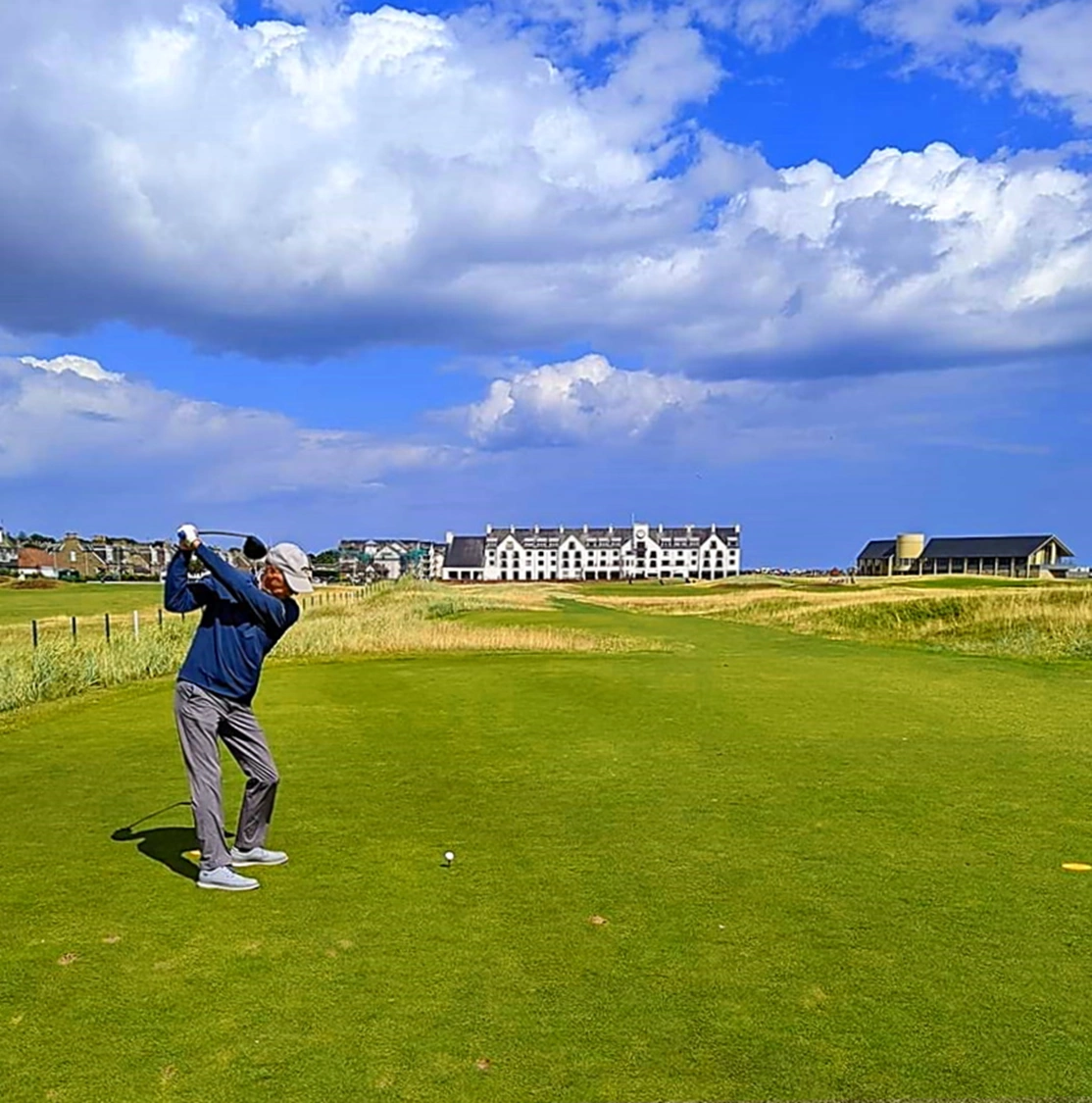
From JCA, Maryland
“I would and will highly recommend your company to anyone looking to plan an unforgettable golf trip. Thank You for putting together a fantastic trip for J.C. and me”
From WF Connecticut
“I think all eight of us would agree that Alun at Faraway Fairways did an absolutely wonderful job of putting this “golf vacation of a lifetime” together for us. His focus on the details was extraordinary from the choice of courses and the timing of the tee times, the amazingly beautiful accommodations along with some excellent meal selections, and the transportation options he provided to get us from place to place.”
From DR South Carolina
“You are about to tee it up in your Major. Seek wisdom, integrity and professionalism. Alun Davies and Faraway Fairways will not disappoint you. They cannot assure a calm sunny day with temperatures in the 70’s on the Old Course.”

From MM, California
“One fantastic trip you organized, and more importantly took ownership of in terms of daily communication and stewardship during our 2+ weeks in Scotland and Ireland. The logistics were spotless…100% of the transports were on time and excellent, the lodging choices spectacular and the golf was off the charts in terms of quality and arrangements made”
DH from California
“You cannot go wrong with the support Faraway Fairways offered. I did this trip solo and all last minute but I have already begun to plan the next trip which will include my best golfing buddies.”
Enquiry
We don't need to make this an ordeal by 101 filtering questions! In reality there are probably little more than half a dozen things we need to know to build out a proposal. The guidance below might help you frame answers
Duration - usually best expressed as a range up to a maximum
Time of year - can be anything from a specific date range to a named season
Travel class - Faraway Fairways uses 'Luxury', 'Premier' or 'Affordable' for generic purposes. You might choose to reference the international 'star' rating system. We're only looking for something to help steer us into the right sector
Self drive or hired driver - In broad terms, self driving is normally less expensive, and much more flexible, but some folk just don't want to do it
Must play courses/ must do places - a few name checks is all that's needed