
The St Andrews Old Course – content duplicated in pages, potential to delete this
The Cradle of Golf - World Ranked Top-10
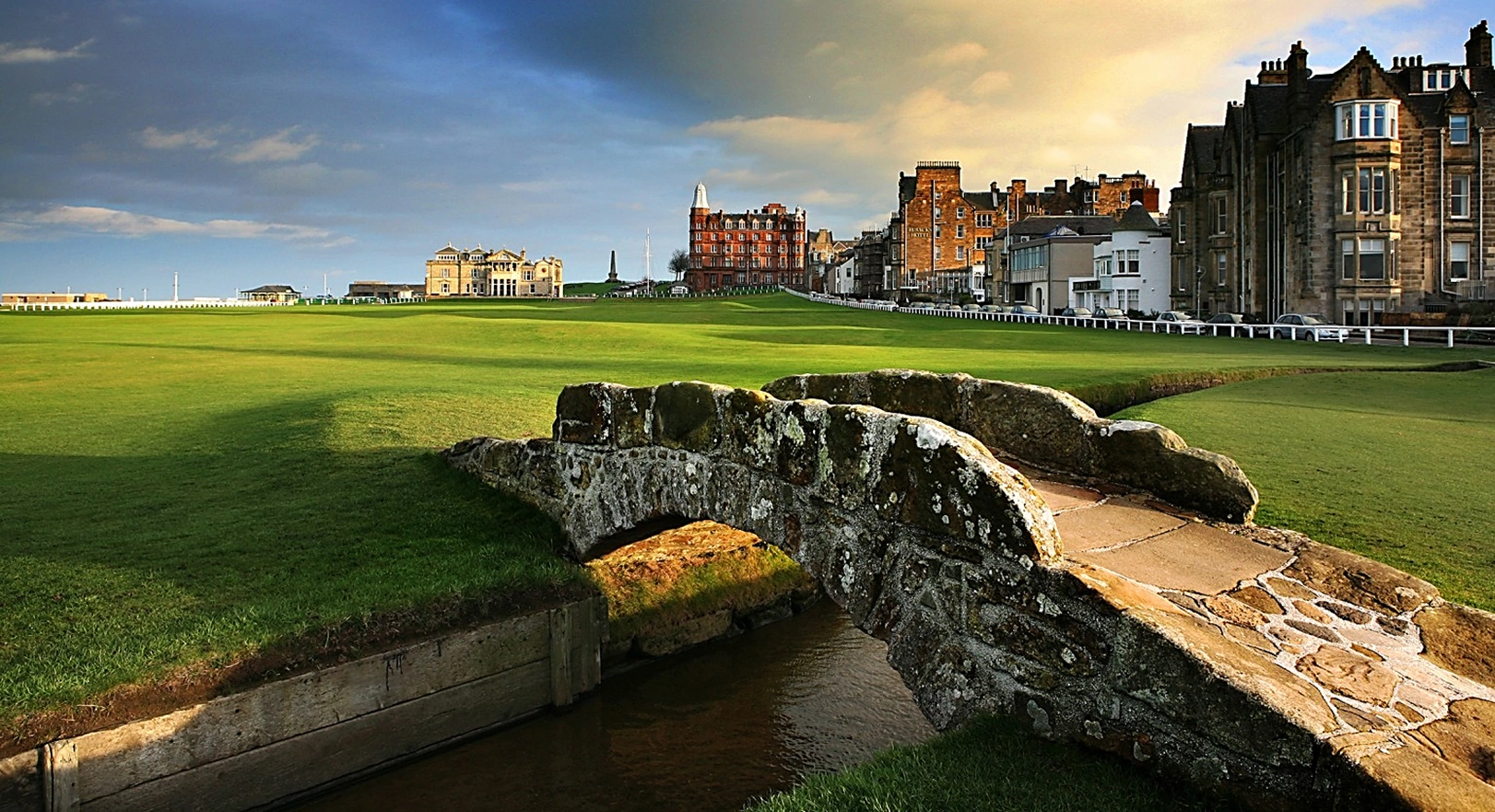
Mythical and Magical
Were you to turn up today at the R&A with a design for the St Andrews Old Course and announce that you expected to be hosting the Open Championship upon building it, you might struggle. Most people know it deep down. The St Andrews Old Course is also a bit of an anachronism, but it also possesses a uniquely magical quality immersed in its heritage and place in the game’s history.
No one knows for certain when it was built, or by whom. It was conceived before earth moving machinery made artificial innovation possible. The course is of a time where golfers looked into the landscape and interpreted hazards and designed holes around what nature had bequeathed them. Calls to try and modernise it have always been tightly controlled. It’ll likely be your round here that will end up consuming the memory as you convince yourself that you could (and should) have gone six shots better. Then it’s ‘got you’
Your first view of the Old Course is always memorable. For many it involves driving down the High Street, turning a short right into Golf Place, driving another 75 yds and then on your left it suddenly reveals itself. Wow!
St Andrews appears in the following itineraries >>>>>>
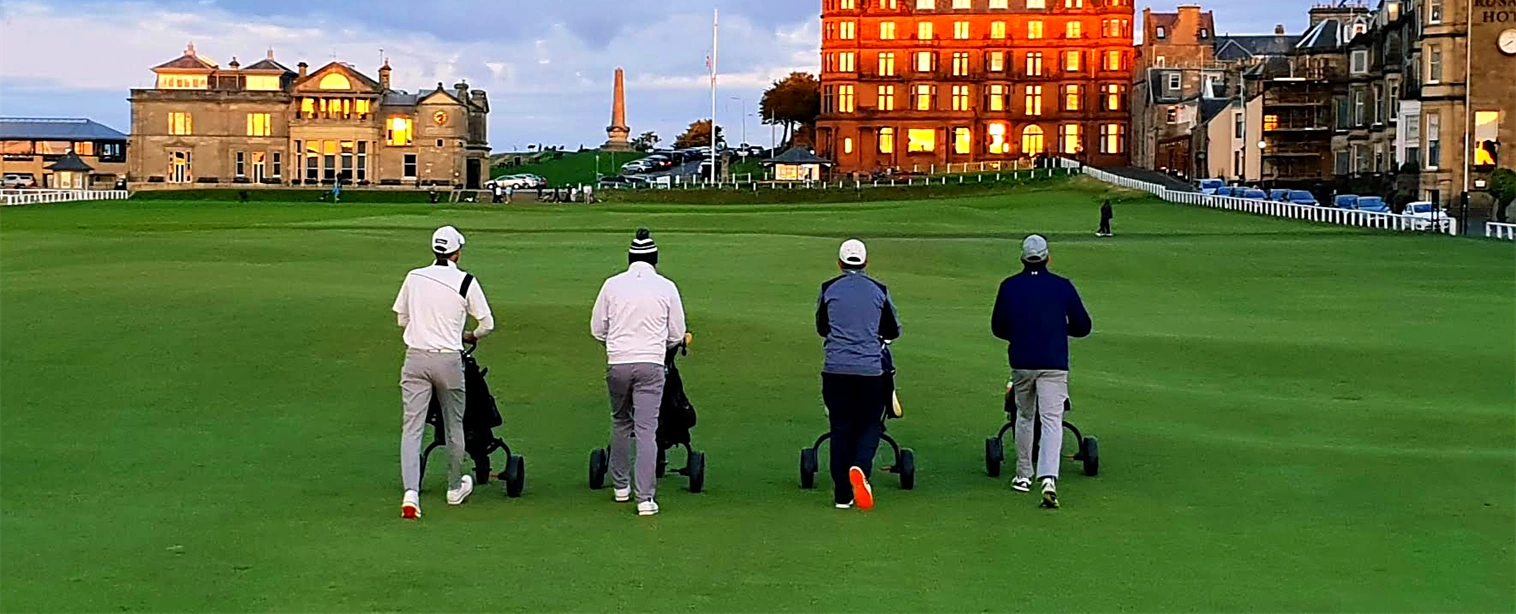
How to include St Andrews
The different ways in which we might access the St Andrews Old Course warrant a separate article. There is a minor science around it
We require a handicap of 36 to play the Old Course. This is enforced
Some of the tours that feature St Andrews include
St Andrews town package
St Andrews with Fife
St Andrews with Carnoustie & Kingsbarns
St Andrews with the West Coast
St Andrews & Edinburgh as part of dual regional package
With St Andrews, the Highlands & Edinburgh as part of a package
Part of the ‘Best Tour’ in Scotland
Part of a Scottish/ Irish combo
Part of Scotland’s Open Championship Venues Tour
A guide to the holes of interest
For many of us, this is likely to be the most nervous we’ll ever feel standing on the tee. Behind the large bay windows of the R&A’s headquarters judgemental members will be watching you drive. There’s a good chance that tourists will be lined up along the adjacent road with phones to the ready too. One appalling shank stands a chance of finding its way onto youtube!
In truth, it takes some missing, the fairway is very wide, although Ian Baker Finch did manage to carve one off to the left and down the road in 1995.
The Swilcan Burn crosses in front of the green with the pin often set close to the front to bring it into play, but it’s really a flick across the water and rarely catches players out.
Flippantly referred to as “the shortest par 5 in Scotland”, the perils of the par 3, eleventh, have long been known about by the long-suffering golfers of St Andrews.
Strath bunker is a small pot bunker on the right side of the 11th green (near the middle of the double green), and Hill bunker is a large, deep bunker on the left side that is the most dangerous hazard. The line off the tee is between the two bunkers to a green that slopes steeply from back to front. Balls that come up short are likely to roll off into a swale fronting the green.
By 2010 the 14th had eclipsed the 6th at Royal Troon and become the longest on the Open Championship rotation when a new tee pushed it out to 618 yards . The 14th is home to one of the Old Course’s most notorious score-wreckers, the somewhat unimaginatively named ‘Hell Bunker’, whose reputation has become so fearsome it puts the almost as deadly Beardies in the shade.
The bunker is 10-foot deep and coming to rest up against its face offers you absolute no way of escaping other than retreating from whence you came, otherwise watch your score multiply as you helplessly thrash about. There have been some horrendous scores returned when the red mist comes down. If you want some consolation however, even Jack Nicklaus took three to get out of here in 1995.
All three scores are possible here, ‘bogey’, ‘double’ and ‘triple’. No hole on the Open rotation plays to a bogey more than the ‘Road Hole’.
The tee-shot is blind, played over a hotel wall into a fairway that narrows the further you try to advance on it. The approach is the key though. The green is narrow and set at 45 degree to the approach. Viewed from above it resembles a peanut, with bulbous ends and a slender middle. Playing to the nearest of these bulges leaves a lengthy putt over a ridge with little prospect of anything better than a par. Trying to hit the middle section is hideously difficult. Not only is it a mere 16yds in width to land on, it is brutally defended. The front is protected by a deep tapering bunker that draws bouncing balls into it. The rear is protected by a swail that rolls down to a road, carrying anything hit too firmly across the tarmac and up against a dry stone wall.
In 1970 Jack Nicklaus drove the 18th green on the St Andrews Old Course. It prompted an old sage to remark “I see you’ve learnt the secret of this game”. Nicklaus took the bait and enquired. “Remove the need for a second shot”. Jack smiled.
In the 2010 this par 4 returned a compassionate scoring average of 3.6288, making it the easiest on the entire rotation. The ‘Valley of Sin’, with a pin placed near the front can cause players to misread a chip or putt from off the surface and have it roll back to their feet, but its otherwise regarded as a friendly hole. In 1995 this is what happened to Costantino Rocca, although he made miracle recovery to hole and force a play-off (which he lost)
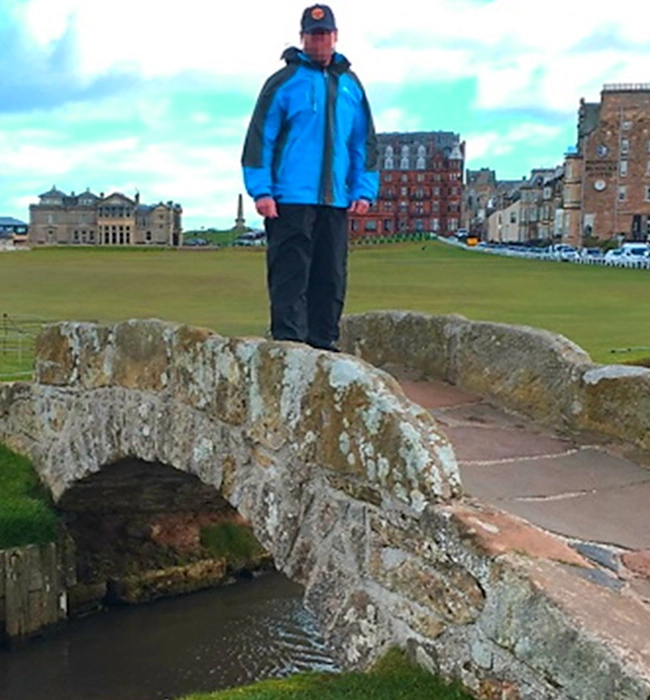
The most famous putt is that of Doug Sanders in 1970. Needing to hole out from two-foot to secure the claret jug in blustery conditions he came off his shot to reset himself. On his second attempt his putt slid agonisingly wide and Nicklaus won the play-off. The hole is probably more about the vista, the Swilcan bridge, and ‘the walk’ up the fairway
Testimonial
From BB Canada
“I told Alun the courses I was interested in playing and he prepared a stay and play package with 14 days of outstanding golf, but also tremendous site seeing opportunities for my wife.”

From JC Illinois
“His attention to detail is amazing--I think our travel plan booklet ran to forty-eight pages, with gorgeous descriptions of cities and sights, plus maps showing where to go to catch trains, or walk from trains to hotels, sights and golf courses, etc.”

From DF Alabama
“I will cherish the memories for a long time- especially the wonderful times spent on and off the golf course with two of my brothers and brother-in-law. None of the memories and golf would have been possible or enjoyed without your tremendous planning and logistical support.”

AS from Colorado
“Alun and Faraway Fairways created possibly the most memorable golf trip we have ever experienced. EPIC is the only word that comes to mind.”
AC, From Florida/ New York, 2025
“We were hopeful to secure a 4 ball at St. Andrews while avoiding the massive expense other operators had quoted. He was very clear about the plan for achieving a tee time at the Old Course through the ballot, including detailed instruction on how it could be done, and what our odds were. He suggested mid- to late April as the best chance of success and advised that this is also the least rainy part of the year. We took his advice and trusted the process. Well, he was right on all counts!”
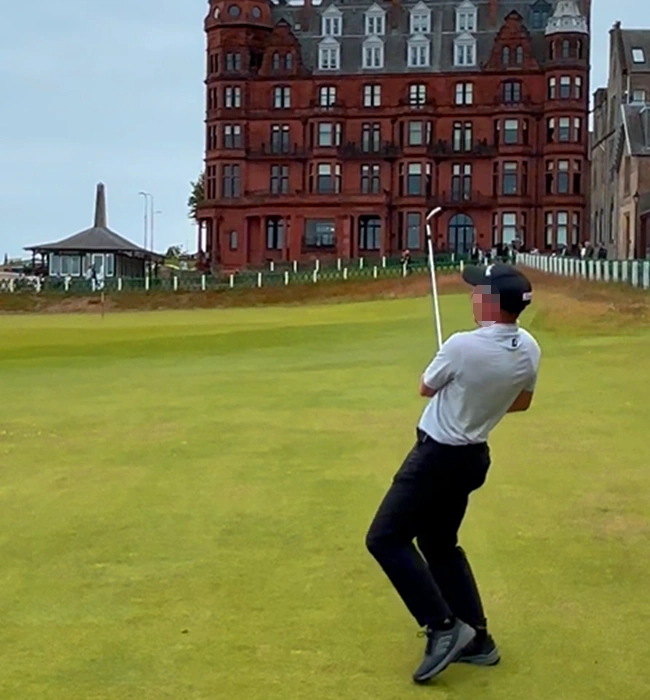
From SB, Minnesota
“We wholeheartedly recommend Alun and Faraway Fairways if you’re looking for a golf trip that is effortless, enjoyable, and truly unforgettable—even for a non-golfer in the mix! My husband and I will be daydreaming about this trip for years to come. 5.5 stars!”

From JB, California
“The best part was that the service was surprisingly affordable. They were thousands of dollars below other quotes that I received, in fact the prices were very similar to what I would have paid if I would have booked everything on my own.”
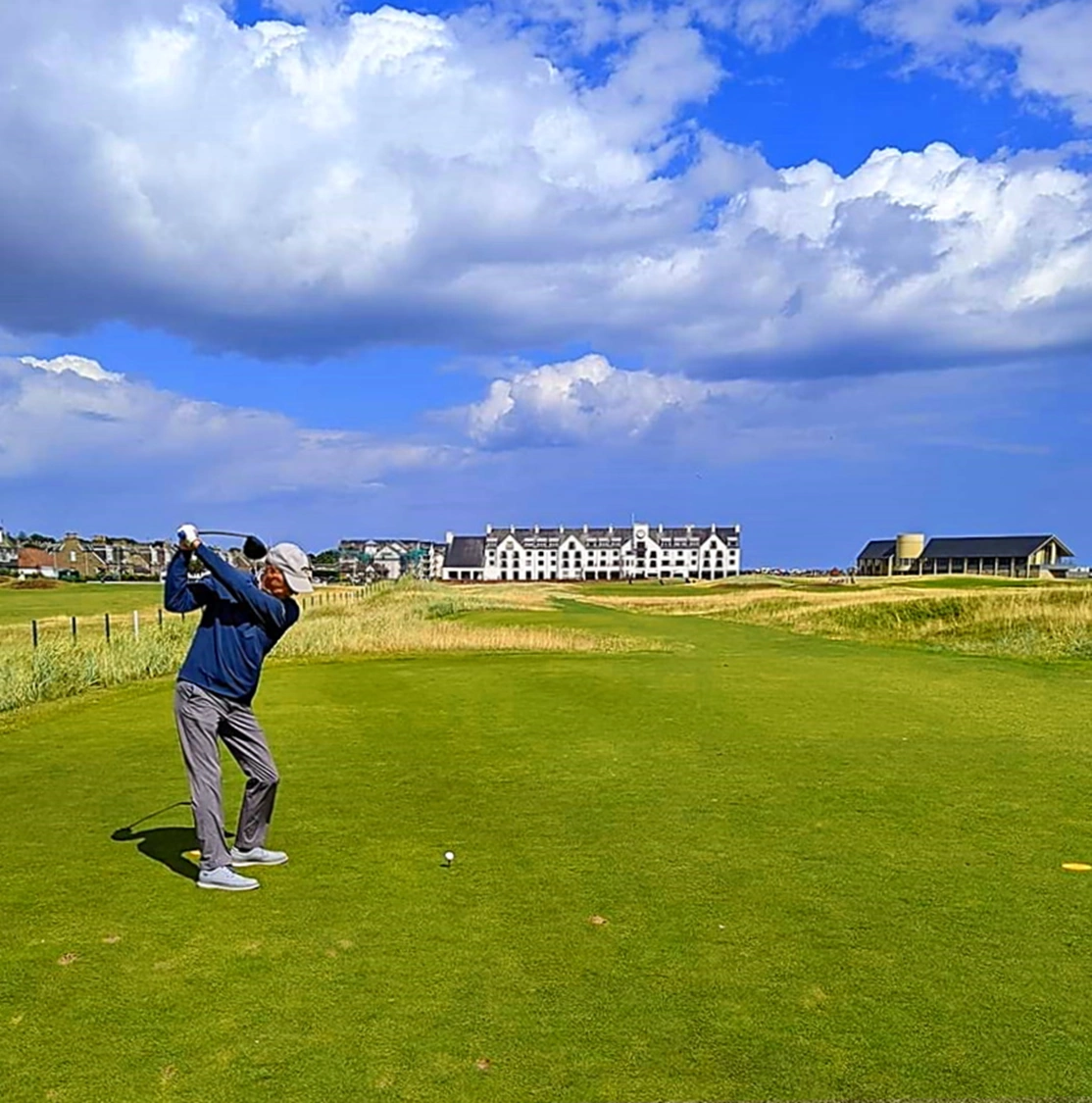
From JCA, Maryland
“I would and will highly recommend your company to anyone looking to plan an unforgettable golf trip. Thank You for putting together a fantastic trip for J.C. and me”
From WF Connecticut
“I think all eight of us would agree that Alun at Faraway Fairways did an absolutely wonderful job of putting this “golf vacation of a lifetime” together for us. His focus on the details was extraordinary from the choice of courses and the timing of the tee times, the amazingly beautiful accommodations along with some excellent meal selections, and the transportation options he provided to get us from place to place.”
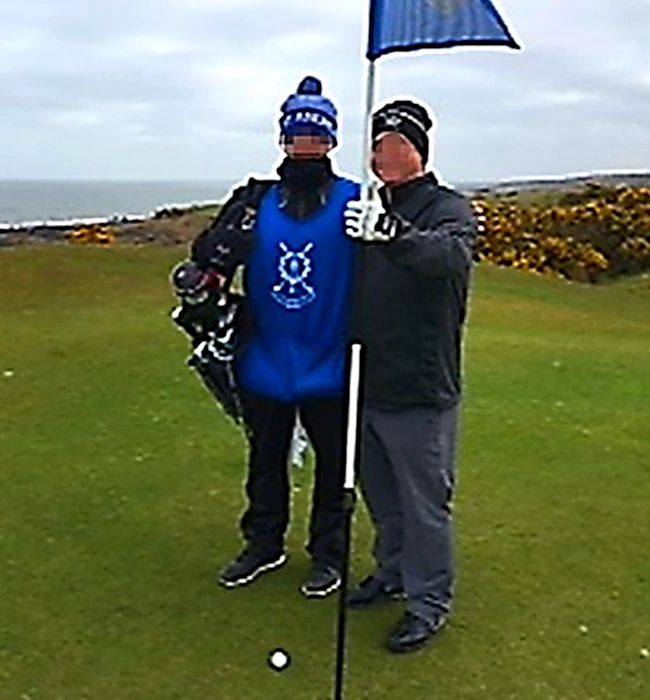
From DR South Carolina
“You are about to tee it up in your Major. Seek wisdom, integrity and professionalism. Alun Davies and Faraway Fairways will not disappoint you. They cannot assure a calm sunny day with temperatures in the 70’s on the Old Course.”

From MM, California
“One fantastic trip you organized, and more importantly took ownership of in terms of daily communication and stewardship during our 2+ weeks in Scotland and Ireland. The logistics were spotless…100% of the transports were on time and excellent, the lodging choices spectacular and the golf was off the charts in terms of quality and arrangements made”
DH from California
“You cannot go wrong with the support Faraway Fairways offered. I did this trip solo and all last minute but I have already begun to plan the next trip which will include my best golfing buddies.”
Enquiry
We don't need to make this an ordeal by 101 filtering questions! In reality there are probably little more than half a dozen things we need to know to build out a proposal. The guidance below might help you frame answers
Duration - usually best expressed as a range up to a maximum
Time of year - can be anything from a specific date range to a named season
Travel class - Faraway Fairways uses 'Luxury', 'Premier' or 'Affordable' for generic purposes. You might choose to reference the international 'star' rating system. We're only looking for something to help steer us into the right sector
Self drive or hired driver - In broad terms, self driving is normally less expensive, and much more flexible, but some folk just don't want to do it
Must play courses/ must do places - a few name checks is all that's needed