
Playing Muirfield on a Scottish Golf Trip – content duplicated in pages, potential to delete this
The Blue-Blooded Aristocrat of Scottish Golf - World Ranked Top-10

A Perfect Collision of Elegance, Class & Heritage
The Honourable Company of Edinburgh Golfer’s relocated from Musselburgh to their new home at Muirfield at the end of the 19th century. When they did a golfing aristocrat was born. Muirfield quickly started to host Open Championships and has been a perennial world-top-10 ranked course ever since.
Traditional out and back links had allowed a savvy golfer to ‘dial into the wind’ and settle on a rhythm. Muirfield adopted a revolutionary design of two loops of nine, turning about 30 degrees at each tee to thwart this metronomic golfer. Consequently the wind never comes from the same place on consecutive holes. Golfers have to continually adjust and read the conditions. It was a design hit. Muirfield is widely regarded as the most complete test of a links player that Scotland has. Their list of Open champions attests to this.
Muirfield appears in the following itineraries >>>>>>
How to include Muirfield
Muirfield only permits visitor play on Tuesday and Thursday
Muirfield will only permit fourball play. If we apply as a threeball, twoball or single golfer, we’ll be declined
Muirfield permit Golf Tour Operators to support 20 priority tee-time applications per season. We’re allowed to nominate three dates up to a maximum of 12 golfers per application
They open their diary for this application in February for play the following year, and it remains open for just six days. After that it closes and our names are drawn randomly
If we fail (we normally succeed) a second public ballot is run about two weeks later to give you another chance
We can include Muirfield as follows
With St Andrews & Edinburgh as part of dual regional package
With St Andrews, the Highlands & Edinburgh as part of a package
Part of the ‘Best Tour’ in Scotland
Part of a Scottish/ Irish combo
Part of Scotland’s Open Championship Venues Tour
A guide to the holes of interest
When Jack Nicklaus was tasked with compiling his best eighteen Open Championship holes he selected Muirfield’s second on his composite course. He reasoned that it offers you a sporting chance. In the right conditions it can be driven by the big-hitters, but an out of bounds wall runs down the left side, coming within 15 feet of the green. The second penalises anything errant.
It this regard its a clever ‘thinkers’ hole. For such a seemingly innocuous hole it has the capacity to reward and punish in equal measure, and above all else, its fair
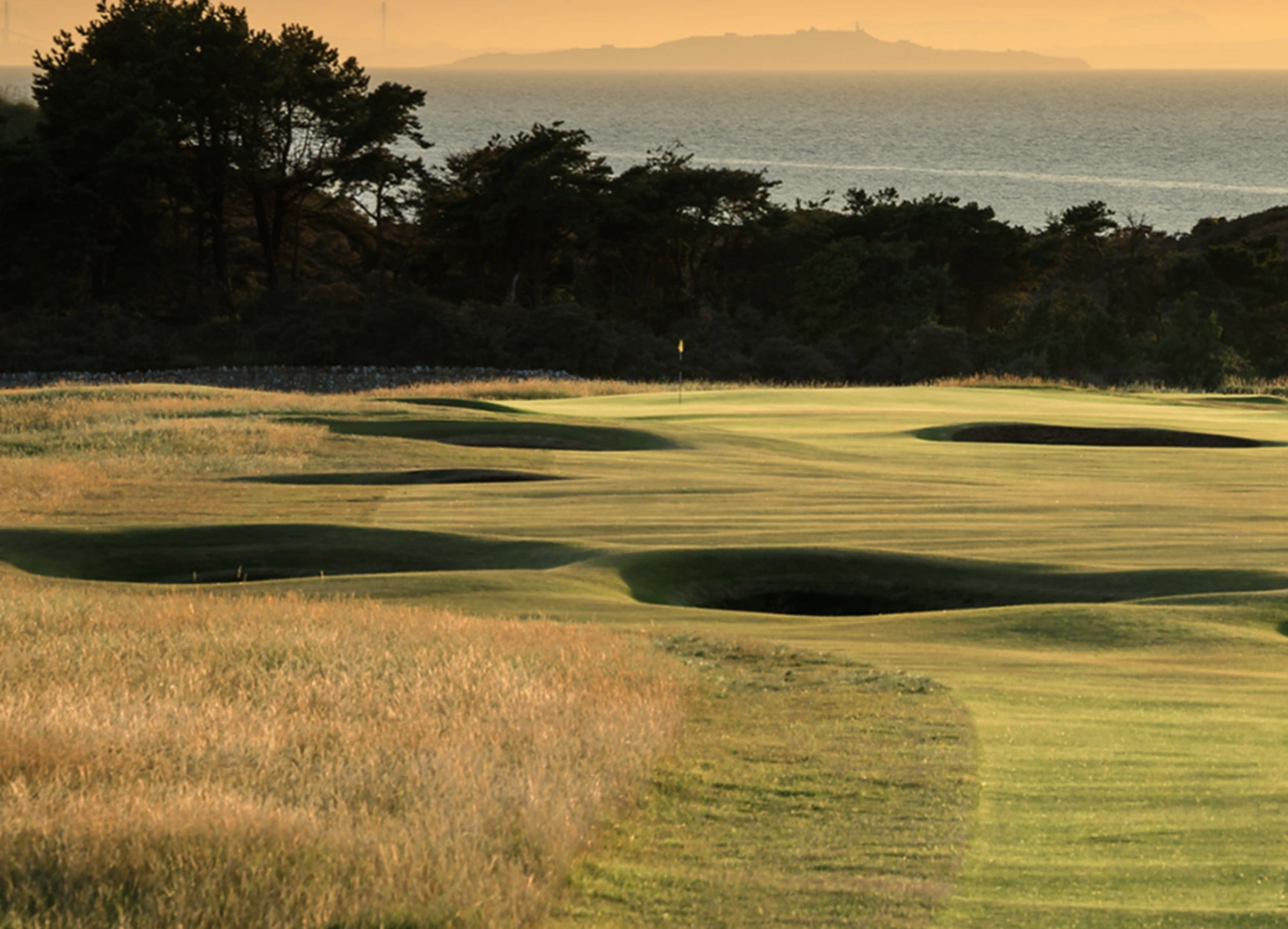
This is probably the most demanding hole on the course. It’s a lengthy dog-leg left, that protects the inside with four penalising bunkers and a blind landing area. The hole almost always plays in a cross wind from right or left, and involves a tee shot over the crest of the fairway, leaving only sky to aim at. The sighting line is a point at the right edge of the furthest right bunker which will set up your best approach angle. The hole then sweeps down and away to the left to a climbing green set against the backdrop of Archerfield Wood. This is an unusual background on a links, and the hidden hollow short of the green, make the pin look a lot closer than it is in reality. The second shot is a tough one to judge. With the rough usually grown out missing the fairway or green altogether will likely result in a lost ball.
Still a bit short by modern par five standards, the hole compensates by playing straight into the prevailing wind, and was tightened up in 2010. The tee shot landing area is squeezed between a deep bunker to the left and thick rough on the right, leading many players to lay up. A careful tee shot however means a more demanding layup for the second.
An aggressive tee shot successfully placed taunts the player to thread the eye of the needle for the green in two. And so the ‘shall I, shan’t I’ debate goes on. Even with a really solid drive it is still very difficult to chase a long running shot past the bunkers on the right to the green. The ninth makes use of the OOB boundary wall, and orientation of the green emphasises a well placed second.
Despite its name, the ‘Barry Burn’ isn’t really in play on the hole.
The sixteenth is the toughest par 3 on the Open Championship rotation by average score. It’s a 245 yard ‘short’ hole, often played into the wind.
Tom Watson had five attempts to get a par here during the 1975 Open Championship and failed to do so every time. In 1968 Jack Nicklaus was the only player to even get past the pin during the final round. Most of the trouble lies at the front which is riddled with bunkers. This hole is really a 3.5 and a par is an outstanding achievement.
One of the great finishing holes in golf and requires two immaculate shots with very little margin for error in either. Two bunkers cut into the fairway on the left side as the fairway reaches its narrowest point, but any tee shot hit too safely to the right is threatened by more sand on that side. The prevailing cross wind from the right enhances the difficulty of the drive and the second shot to a long rising green. The green itself is guarded by deep bunkers on either side and is long and rising. The bunker on the right is the iconic ‘Island Bunker’
Testimonial
From BB Canada
“I told Alun the courses I was interested in playing and he prepared a stay and play package with 14 days of outstanding golf, but also tremendous site seeing opportunities for my wife.”

From JC Illinois
“His attention to detail is amazing--I think our travel plan booklet ran to forty-eight pages, with gorgeous descriptions of cities and sights, plus maps showing where to go to catch trains, or walk from trains to hotels, sights and golf courses, etc.”

From DF Alabama
“I will cherish the memories for a long time- especially the wonderful times spent on and off the golf course with two of my brothers and brother-in-law. None of the memories and golf would have been possible or enjoyed without your tremendous planning and logistical support.”

AS from Colorado
“Alun and Faraway Fairways created possibly the most memorable golf trip we have ever experienced. EPIC is the only word that comes to mind.”

AC, From Florida/ New York, 2025
“We were hopeful to secure a 4 ball at St. Andrews while avoiding the massive expense other operators had quoted. He was very clear about the plan for achieving a tee time at the Old Course through the ballot, including detailed instruction on how it could be done, and what our odds were. He suggested mid- to late April as the best chance of success and advised that this is also the least rainy part of the year. We took his advice and trusted the process. Well, he was right on all counts!”
From SB, Minnesota
“We wholeheartedly recommend Alun and Faraway Fairways if you’re looking for a golf trip that is effortless, enjoyable, and truly unforgettable—even for a non-golfer in the mix! My husband and I will be daydreaming about this trip for years to come. 5.5 stars!”

From JB, California
“The best part was that the service was surprisingly affordable. They were thousands of dollars below other quotes that I received, in fact the prices were very similar to what I would have paid if I would have booked everything on my own.”
From JCA, Maryland
“I would and will highly recommend your company to anyone looking to plan an unforgettable golf trip. Thank You for putting together a fantastic trip for J.C. and me”
From WF Connecticut
“I think all eight of us would agree that Alun at Faraway Fairways did an absolutely wonderful job of putting this “golf vacation of a lifetime” together for us. His focus on the details was extraordinary from the choice of courses and the timing of the tee times, the amazingly beautiful accommodations along with some excellent meal selections, and the transportation options he provided to get us from place to place.”
From DR South Carolina
“You are about to tee it up in your Major. Seek wisdom, integrity and professionalism. Alun Davies and Faraway Fairways will not disappoint you. They cannot assure a calm sunny day with temperatures in the 70’s on the Old Course.”

From MM, California
“One fantastic trip you organized, and more importantly took ownership of in terms of daily communication and stewardship during our 2+ weeks in Scotland and Ireland. The logistics were spotless…100% of the transports were on time and excellent, the lodging choices spectacular and the golf was off the charts in terms of quality and arrangements made”
DH from California
“You cannot go wrong with the support Faraway Fairways offered. I did this trip solo and all last minute but I have already begun to plan the next trip which will include my best golfing buddies.”